

CLRS Is the Review Manual for Machine-Written Code
When agents write the code, the classic algorithms textbook becomes a review manual.

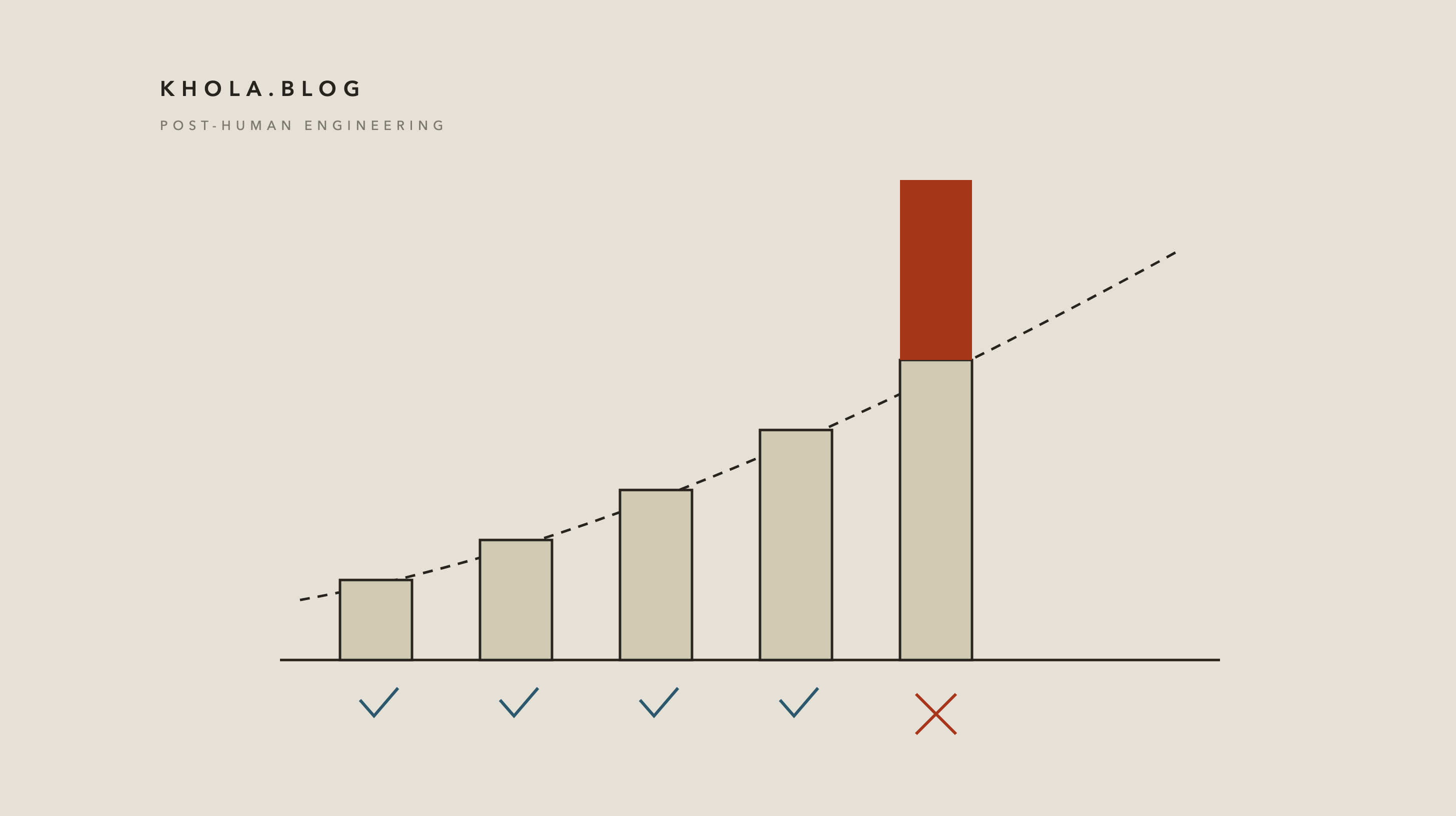
I do not want to write another memory-wall post. Khola.Blog has already asked modern CPUs to testify under oath, and they have been very clear: scattered memory is expensive.
The more interesting reread of Introduction to Algorithms in 2026 is not that the RAM model hides cache behavior. It does. That is old news here.
The interesting part is that CLRS becomes more important when code is cheap.
When an agent writes an algorithm, the first question is no longer “can someone type the implementation?” The first question is “what did this implementation promise, and can I prove it kept the promise?”
That is the part of CLRS that survives. Not the fantasy that every memory access costs the same. Not the idea that a textbook data structure is automatically a production data structure. The durable part is the discipline: invariants, bounds, recurrences, amortized reasoning, reductions, and worst-case analysis.
I do not read CLRS as a performance manual. I read it as the language a reviewer needs when the patch was written by something fast, confident, and indifferent to production.
The Book Is About Promises
The most useful thing CLRS teaches is not a catalog of named algorithms. It is a way to talk about promises.
A loop invariant says what must remain true before and after each iteration. A worst-case bound says what happens when the input stops being friendly. Amortized analysis says when a rare expensive operation is paid for by a sequence. A reduction says one problem is at least as hard as another. Work and span say parallelism has a critical path, no matter how many processors the scheduler can see.
Those ideas are not academic decoration. They are review tools.
If a generated function claims to maintain a sorted prefix, I want the invariant. If it claims expected linear time, I want to know where the randomness comes from and who can influence the input. If it claims amortized constant time, I want to know whether the tail event is acceptable in the caller’s fault domain. If it spawns work aggressively, I want to know where the span ends and where coordination overhead starts.
Sample tests do not answer those questions. They show that the code survived a small cross-examination.
CLRS gives a reviewer the better cross-examination.
The RAM Model Stops At The Hot Path
The RAM model is a deliberate simplification. It gives every ordinary memory access a constant cost so the proof can focus on how the algorithm scales.
That is not a bug in CLRS. That is the contract of the model.
The mistake is carrying that model into a hot path after the proof is done. Two traversals can both be O(n) and still behave nothing alike. A scan over a contiguous vector gives the processor a boring access pattern. A walk through a linked structure creates a chain of dependent addresses. The notation groups them together because asymptotic analysis is answering a different question.
This is why I do not want the CLRS post to become another cache sermon. The hardware lesson matters, but it is not the main event. The practical rule is smaller:
Use CLRS to prove the shape of the algorithm. Use the machine to price the implementation.
Big-O gets the first vote. The profile gets the final one.
Production Libraries Are Edited Algorithms
The best production algorithms are rarely naked textbook algorithms. They are edited algorithms.
Rust 1.81 began replacing its stable and unstable slice sorting implementations, but it took until Rust 1.95 in April 2026 to finally roll the new logic out across every single sort_by, sort_by_key, and select_nth variant in the standard library. The new algorithms improve runtime performance and compilation time, and also actively try to detect incorrect Ord implementations that would prevent a meaningful sorted result.
That second point is the one I care about for this post.
Sorting is not just “put these values in order.” Sorting assumes the comparison relation behaves like an order. If the comparator violates that contract, the algorithm is no longer operating on the problem it was designed to solve. Rust’s current slice documentation describes the stable sort as based on driftsort, combining quicksort’s fast average case with mergesort’s worst-case behavior and run detection. It also warns that invalid ordering can panic or produce unspecified order. Making that safe and fast across every variant required deep, layout-aware engineering. The textbook algorithm is just the starting point; the production implementation is an exercise in managing the machine.
That is CLRS in production clothing: the algorithm needs a mathematical contract before performance even enters the room.
Hash tables make the same point from the data-structure side. Abseil’s Swiss Table design notes describe metadata bytes and group matching for lookup. Its container guide recommends absl::flat_hash_map and absl::flat_hash_set for general use, while spelling out the trade-off: flat storage helps the general case, but rehashing invalidates pointers and node-based variants still matter when pointer stability is required.
That is the engineering version of the CLRS lesson. The asymptotic target is not enough. The implementation has to choose which promise matters: lookup speed, pointer stability, memory overhead, iteration behavior, adversarial input resistance, or migration safety.
The textbook gives the vocabulary. The library makes the trade.
The New Failure Mode Is Plausible Wrong Code
The dangerous agent output is not always nonsense. Nonsense is easy.
The dangerous output compiles. It has the right shape. It imports the local helper. It passes the examples in the prompt. It looks boring enough to merge.
Then the comparator is not a total order. The recursive dynamic program has no real memoization boundary. The randomized algorithm uses a predictable source. The priority queue choice is fine for the lecture but wrong for the update pattern. The graph traversal mutates the structure whose invariant it is pretending to inspect.
These are not aesthetic failures. They are contract failures.
A human reviewer can miss them too. The agentic shift just changes the volume and confidence of the patches. It moves the hard work from writing code to rejecting code that is plausible but underspecified.
That is why the review should not begin with style. Style can wait. First, I want the algorithmic contract:
What invariant does this code preserve?
What is the worst case, and who can trigger it?
Is the expected-case argument relying on randomness, distribution, or trust?
Does the amortized event fit the caller’s latency budget?
Which input breaks the mental model but still satisfies the type signature?
Is this a place to use a standard library implementation instead of generated code?
If the path becomes hot, what data layout does the proof ignore?
That checklist is not anti-agent. It is anti-magic.
The Margin Note
I would not write “the RAM model is a lie” in my copy of CLRS. That is too cute and not quite true.
I would write this instead:
Valid for proof. Insufficient for cost. Mandatory for review.
The first sentence protects the book. The second protects the system. The third is the update for machine-written code.
CLRS does not teach agents to write good software. It gives humans the language to reject software that only looks good. That distinction matters more now, not less, because the cost of producing plausible code has collapsed.
The workflow does not just need faster generation. It needs stricter judgment. Every generated algorithm still owes the same debt: state the invariant, respect the bound, name the bad input, and prove that the implementation you shipped is the one the proof was talking about.