


Structure and Interpretation of Computer Programs teaches that computer science is a branch of mathematical logic. It builds processes in an idealized sandbox where memory is infinite, pointer dereferences are instantaneous, and execution frames carry zero cost.
Nevertheless, in the systems of 2026, hardware is not a mathematical plane. It is a thermal and spatial grid. The elegant abstractions of classical computer science run directly into microarchitectural bottlenecks. Specifically, lexical environments and closures collapse under the physical constraints of the memory wall.
Structurally, we must discard the illusion of infinite memory to analyze how software structures interact with the silicon layer.
The Microarchitectural Cost of Pointer Chasing
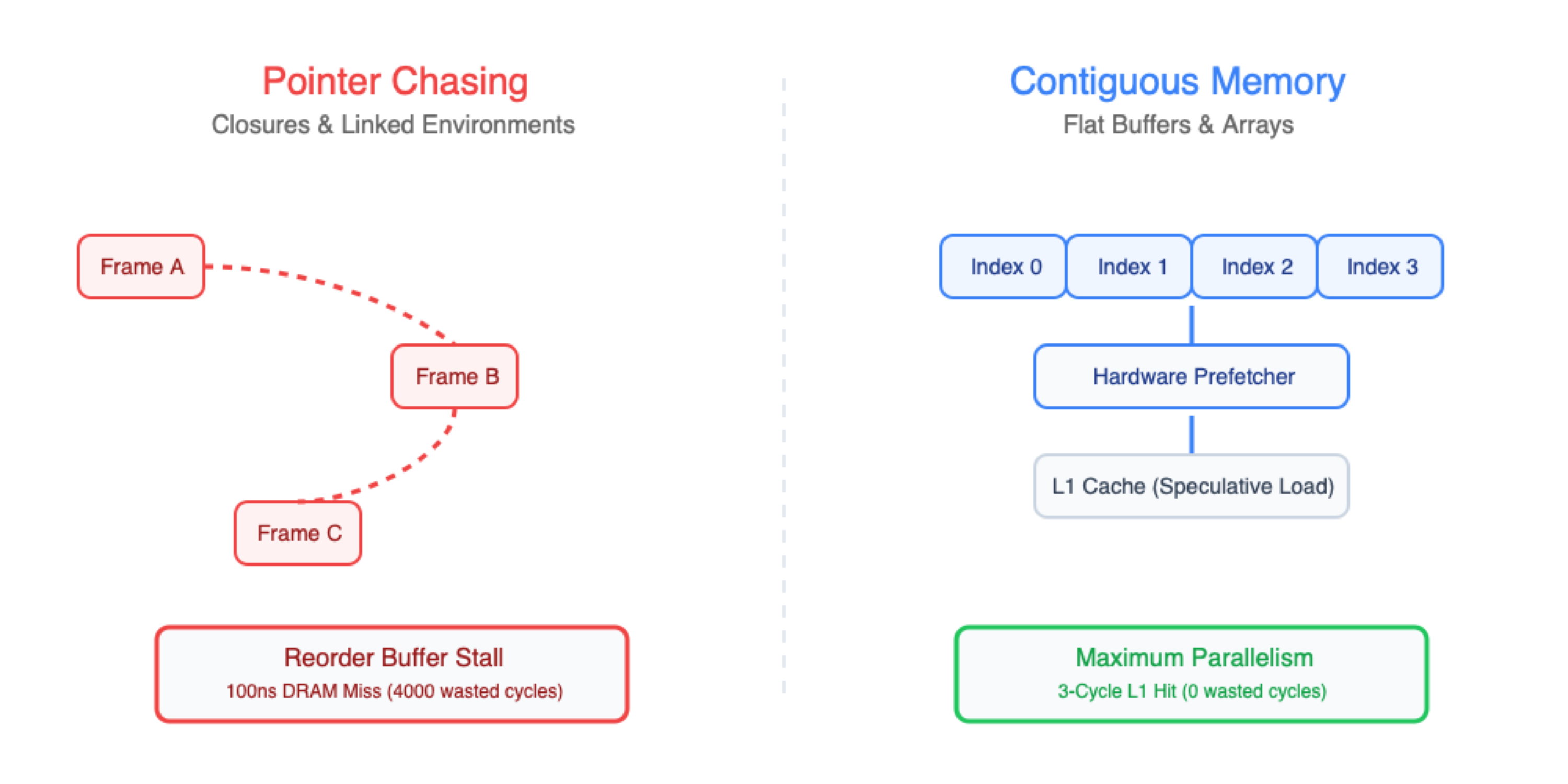
Modern out-of-order execution engines derive their massive throughput from memory-level parallelism. Linear array scanning aligns perfectly with hardware prefetchers, allowing the CPU to compute the address of the next contiguous element instantly. Speculative loads pull cache lines into the L1 cache before the execution engine requests them. Consequently, the effective latency approaches the blazing fast 3-cycle L1 speed of the Apple M4.
Conversely, sequential pointer chasing is inherently hostile to modern hardware pipelines. Lisp pairs, binary trees, and deeply nested closures rely on scattered heap allocations. When traversing a linked list, the exact memory address of the subsequent node remains unknown until the current node’s payload is fetched from main memory.
This serialization creates an unbreakable dependency chain that blinds the hardware prefetcher. As memory-level parallelism collapses, the Reorder Buffer rapidly fills with stalled instructions, forcing the execution unit to wait out the agonizing 100-nanosecond latency of DRAM.
Because a modern processor operates near 5 GHz, a single DRAM access wastes 500 clock cycles. If the CPU possesses a decode width of 8 instructions per cycle, the penalty is severe. The processor throws away over 4,000 potential instruction executions per memory hop. Thus, pointer chasing forces massive CPUs to operate at a fraction of their theoretical throughput.
The Jungle Walk Mental Model
Imagine driving on a straight highway where you speculatively look ahead and accelerate. The CPU prefetcher is your cruise control, bringing the road ahead into view before you reach it. Pointer chasing is like walking through a dense jungle with a machete. You cannot see the next step until you clear the immediate brush. Your speed is restricted to how fast you clear each step, forcing your massive out-of-order cores to stand idle.
The Bridge: How Environments Map to Silicon
The penalty of pointer chasing extends far beyond isolated CPU cache misses; it fundamentally dictates the failure modes of distributed edge infrastructure. An environment frame (or a closure) is a massive, deeply nested graph of pointers scattered across the heap.
Serverless platforms like AWS Lambda and Cloudflare Workers promote a strict stateless execution model. However, to bypass the extreme latency of cold starts, these platforms maintain warm execution environments by reusing the underlying container or V8 isolate across multiple sequential invocations. When a V8 isolate keeps a closure “warm”, it is effectively keeping that massive, scattered pointer graph alive. When the runtime must traverse this graph (either during execution or garbage collection sweeps), it defeats the CPU’s hardware prefetcher. Simultaneously, the sheer volume of retained state shatters the memory limits of the serverless container.
The Stale Air Lock Mental Model
Serverless warm environments are like a submarine air lock reused without flushing. The global frame is the main chamber, whereas the local handler invocation is the inner chamber. If stale credentials or closures are left in the main chamber, the next occupant breathes toxic air, inheriting the corrupted, recirculated state.
AWS Lambda Closure Scope Retention
A prominent pathology involves aggressively caching data in the global scope. In one documented incident, an engineering team deployed an image generation pipeline on AWS Lambda by initializing asynchronous callbacks outside the handler. Under sustained load, the closures created during each invocation captured strong references to massive buffer arrays.
Because the global environment frame retained strong bindings to these scattered closures, the V8 garbage collector was entirely blocked from reclaiming the memory. The Resident Set Size climbed relentlessly with each warm invocation until the container exhausted its 5 GB memory limit and was terminated via SIGKILL. The resolution required strictly scoping mutable arrays to the local execution frame inside the handler, ensuring complete destruction upon function termination.
Cloudflare Workers Credential Bleed
State bleed also corrupts configuration security. On March 21, 2025, Cloudflare’s R2 object storage experienced a massive global outage caused by an architectural failure to strictly isolate global environment frames. During a routine key rotation, an engineering team inadvertently pushed new authentication credentials to a development instance instead of production.
When the old credentials were deleted from the backend, the production Workers were left holding a stale, globally bound context frame. Because the Worker reused its warm environment, it continued attempting to authenticate using the deleted keys. The resolution required deploying updated credentials to force the instantiation of new environment frames.
Bridging the Abstraction Gap
Ultimately, physical hardware realities dictate high-performance software architecture. Lisp’s elegant functional model has not failed, but it breaks down completely in hot-path, high-throughput data processing. Tree structures and closures remain perfectly valid for high-level business logic where the network is the actual bottleneck.
Nevertheless, the memory wall mandates contiguous memory arrays and explicit Data-Oriented Design (DOD) for performance-critical execution. Flat buffers and static memory layouts respect the physical thermal grid. In summary, if hot-path software abstraction ignores the hardware substrate, the inevitable outcome is a massive spike in latency.